Peptide Reconstitution Calculator for BPC-157
Free peptide reconstitution calculator. Enter vial size in mg and water volume in ml to get concentration per unit. Reference math not dosing advice.
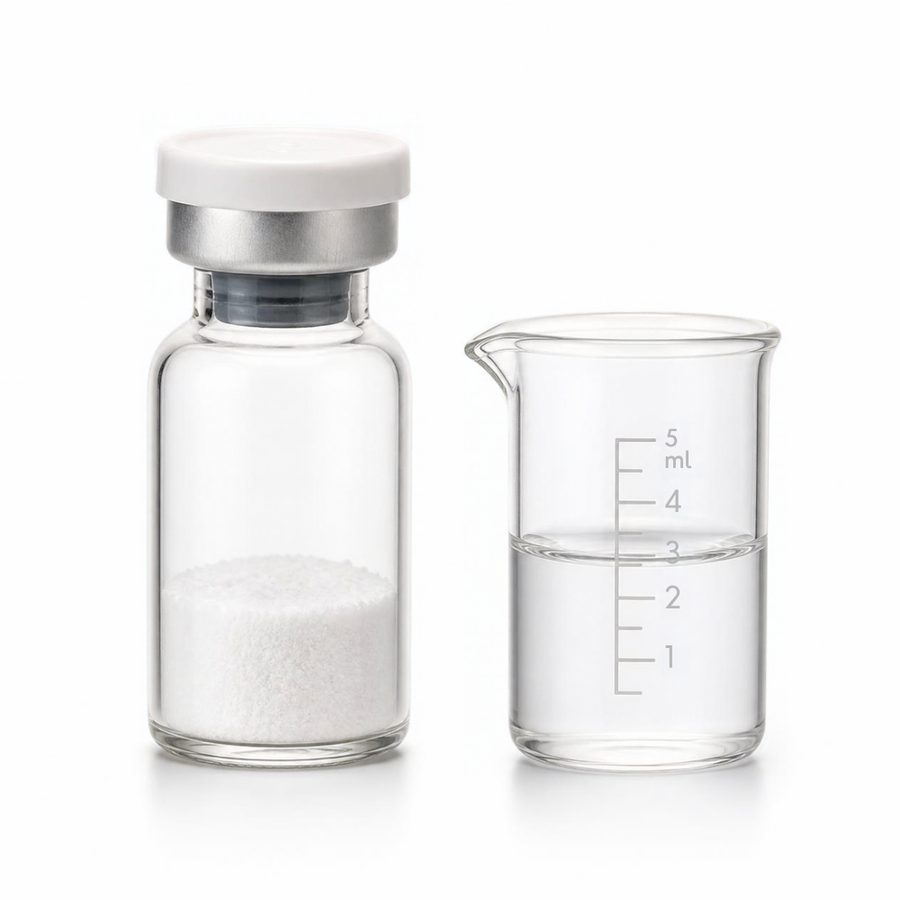
Reconstitution is simply a matter of performing simple division. You take the amount of peptide contained in the vial and divide it by the amount of water you are adding. The answer represents how many micrograms of peptide are contained in each volume unit of the syringe. We created this calculator so that you can do this calculation easily and quickly to double-check your data or try out various options according to the vials’ sizes and water amounts.
How the Reconstitution Calculator Works
Inputs - Peptide Amount and Water Volume
You will need to enter two figures. The first number is the total quantity of peptide in the vial in milligrams (mg). This figure is shown on the vial label. The second number is the volume of bacteriostatic water that you plan to use, expressed in milliliters (ml). After that, the calculator will produce a concentration figure for the peptides by dividing the weight of peptides by the volume of water used for dilution.
Output - Concentration and Units Per Tick
The output provides concentration in micrograms per 0.1 mL (equivalent to one “10 IU” mark on a regular 100 units insulin syringe). It also indicates how many micrograms equal to one tick mark. It is so possible to count ticks to achieve volume in question. The same arithmetic applies for any peptide with the only difference being the input numbers.
Worked Example - 5 mg BPC-157 Vial
- Check the vial label Confirm the vial contains 5 mg of BPC-157 (5,000 mcg).
- Draw bacteriostatic water Pull 2 ml of bacteriostatic water into an insulin syringe or mixing syringe.
- Inject water into the vial Push water slowly down the inside wall of the vial. Do not spray directly onto the powder.
- Swirl gently Roll the vial between your palms until the powder dissolves. Do not shake.
- Calculate concentration 5,000 mcg divided by 2 ml equals 2,500 mcg per ml. Each 0.1 ml (10 IU on a 100-unit syringe) contains 250 mcg.
Adding 2 ml Bacteriostatic Water
Many people opt for 2 ml for a 5 mg vial due to the fact that the concentration becomes 2500 mcg/ml which gives neat numbers for all the markings of the syringes. It is known that one tick on a 100-unit insulin syringe equals 0.01 ml, so one tick corresponds to 25 mcg of a solution. Similarly, 10 ticks (0.1 ml) equal 250 mcg. So the mathematics becomes simple eliminating the possibility of making mistakes with decimal numbers.
Reading the Result on a 100-Unit Syringe
A 100-unit needle has a total volume of 1 ml. The calibration on the needle ranges from 0 to 100, with calibrations spaced out by either 1 or 2 units depending on the type of needle used. The “unit” marking indicates 0.01 ml; each unit on the needle so corresponds to 25 mcg of peptide since there are 2,500 mg/ml in the vial.
Reference Table - Common Vial and Water Combinations
| Vial (mg) | Water (ml) | Concentration (mcg/ml) | mcg per 0.1 ml | mcg per 1 IU (0.01 ml) |
|---|---|---|---|---|
| 5 | 1 | 5,000 | 500 | 50 |
| 5 | 2 | 2,500 | 250 | 25 |
| 5 | 2.5 | 2,000 | 200 | 20 |
| 5 | 5 | 1,000 | 100 | 10 |
| 10 | 1 | 10,000 | 1,000 | 100 |
| 10 | 2 | 5,000 | 500 | 50 |
| 10 | 3 | 3,333 | 333 | 33.3 |
| 10 | 5 | 2,000 | 200 | 20 |
| 10 | 10 | 1,000 | 100 | 10 |
5 mg Vial Concentrations
If 5 mg can be added to 1 ml, the maximum level of concentration will be gained at 5,000 mcg/ml. This indicates that one unit from the syringe will be equal to 50 mcg. So it can be too concentrated for measuring small volumes accurately. When 2 ml is added, the concentration reduces to 2,500 mcg/ml and decreases to 1,000 mcg/ml if 5 ml is added. More water means the more diluted solution and so measuring small amounts with the ordinary insulin syringe becomes easier. These combinations are included since they include the most reconstitution cases.
10 mg Vial Concentrations
A 10 mg container with 2 ml of water gives 5,000 mcg/ml, which is the same level as a 5 mg container with 1 ml. Real Peptides offers 10 mg BPC-157 container (SKU RP-BPC10V) for $43.20. Adding 2 ml of bacteriostatic water to this container will result in 500 mcg per 0.1 ml. When 5 ml of water is used, each 0.1 ml contains 200 mcg. So the amount of water should be chosen in accordance with a proper concentration for the amounts you plan to use.
Units, Ticks, and Common Mistakes
IU vs Units on an Insulin Syringe
The abbreviation "IU" in the insulin syringe stands for International Units and denotes a measure of insulin. In the case of the peptides, the markings on the syringe are just volume indicators. So one "unit" is equal to 0.01 ml of liquid. This “IU” does not correspond to any biological potency unit of insulin or of hCG. It is only a volume measure. This fact is important as many first-time users get confused.
mcg vs mg - The Decimal That Matters
Milligram (mg) can also be defined as one-thousandth of gram and as equal to 1,000 micrograms (mcg). If you confuse these two units, errors this large will be encountered. If you take, for example, a vial containing 5 mg of something, it will be equal to 5,000 mcg and if you take 5 instead of using 5,000 in calculations, every subsequent number will be off by 1,000 times.
FAQ - Reconstitution Calculator
How much bacteriostatic water do I add?
You can decide how much water to use. Using more water makes the solution diluted, which allows you to make more accurate measurements of small amounts. Using less water makes the solution concentrated, which allows you to use less syrup. Common amounts of water used are 1, 2, or 5 ml. The calculation is performed in the calculator for any amounts selected.
What does mcg per unit mean?
This refers to how much peptide is in one "unit" of your insulin syringe, since one "unit" equals 0.01 ml. This will vary depending on how concentrated your solution is. For instance, a concentration of 2,500 mcg/ml means that one unit of your syringe will provide 25 mcg of peptide.
Can I use this calculator for other peptides?
Yes. The calculations will work exactly the same with any lyophilized peptide when mixed with bacteriostatic water. Enter the total mass of peptide indicated on the label of the peptide vial and the amount of water added for the calculation. The calculations will include BPC-157, TB-500, MOTS-C or any peptide powder. Real Peptide sells bacteriostatic water (10 ml, USP-grade, 0.9% benzyl alcohol) for $4.80 in case anyone is in need of a supply source.
Where can I buy bacteriostatic water?
Real Peptides sells bacteriostatic water for $4.80 per 10 ml vial with 0.9% benzyl alcohol, of USP quality. In addition to Real Peptides, bacteriostatic water can be obtained through medical supply companies and some pharmacies. The presence of benzyl alcohol in the bacteriostatic water makes it a useful product during a long period of time.
Compare the current picks
Prices, sizes and ratings side by side, updated when the merchant pages change.
Compare sources