BPC-157 Dosage in Units — mcg to IU Conversion
BPC-157 dosage in units explained. Convert mcg to syringe units with a known concentration using step-by-step math and reference tables.
Determining the "dosage in units" of BPC-157 is more like doing a conversion than solving a pharmacological problem. Syringe units are calibrated in units of volume rather than peptide mass. So the number of micrograms of BPC-157 contained in a given number of units depends entirely on the concentration of the reconstituted solution. This, in turn, depends on how much peptide was in the vial and how much water we added. We will go over the formula and provide a reference table with numbers and common mistakes.
BPC-157 Dosage in Units - What the Numbers Mean
mcg, mg, IU, and Syringe Ticks Explained
Four terms get tangled in online discussions. Here is what each one actually means:
- mg (milligram) - One thousandth of a gram. Vial labels list total peptide content in milligrams (e.g., 5 mg or 10 mg).
- mcg (microgram) - One thousandth of a milligram, or one millionth of a gram. Published study doses for BPC-157 are reported in mcg/kg. 1 mg = 1,000 mcg.
- IU or "units" on an insulin syringe - These are volume markings. On a standard 100-unit insulin syringe, 100 units equals 1 ml. Each unit equals 0.01 ml. The term IU here does not refer to International Units of biological potency.
- Tick marks - The individual lines printed on the syringe barrel. On a 100-unit syringe, the smallest tick usually represents 1 or 2 units depending on the manufacturer.
The main point to be noted: that syringes are made to measure volume not weight. Hence, the amount of peptide in a given volume is dependent upon its concentration.
Why Units Depend on Your Concentration
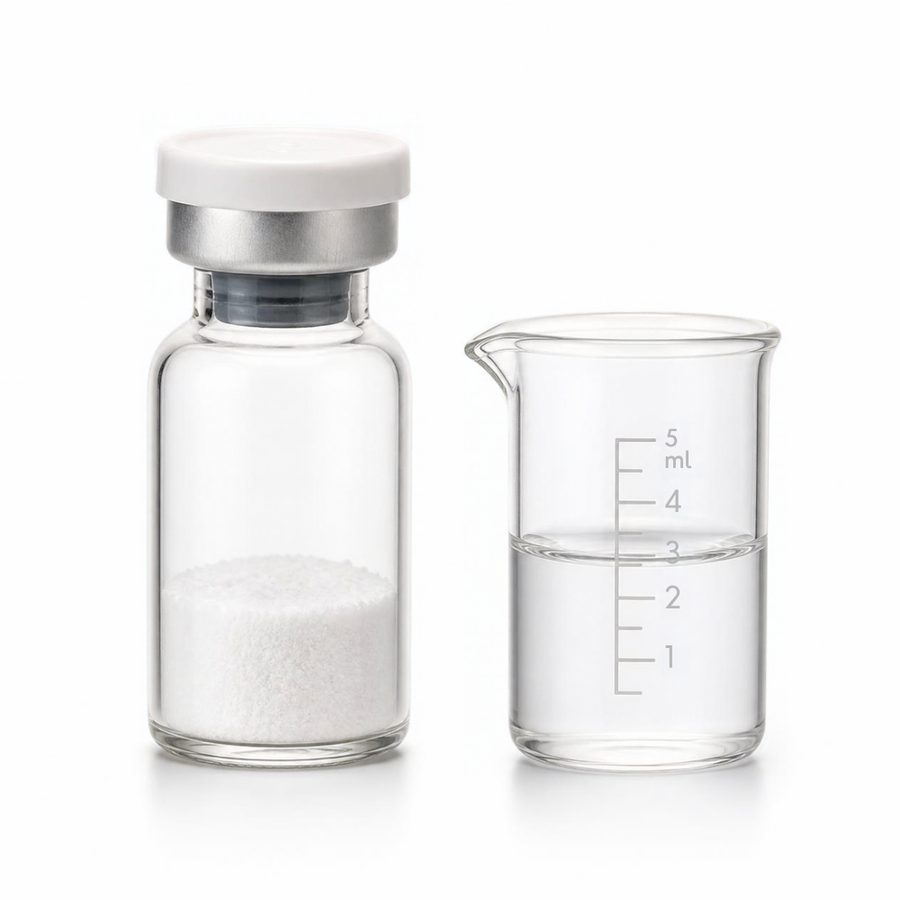
The process of adding bacteriostatic water to a vial containing a given amount of powder will yield different concentrations of the substance in question. For the example of adding 2 ml of water to a vial containing 10 mg of powder, each 0.01 ml of the vial's liquid would contain 50 mcg of the substance. However, if we use 5 ml of water instead of 2 to dilute the original vial, we will get that each 0.01 ml of liquid would contain only 20 mcg of the original substance. So we have the same total amount of drug in the vat after the dilution process, but the more liquid we use to dilute the substance, the bigger volume it occupies. So the meaning of the instruction "take 10 units" becomes ambiguous, as 10 units of diluted substance can equal either 500 mcg at some concentration or 100 mcg at another.
Conversion Formula
Step 1 - Know Your Vial Size in mg
Check the vial labeling. They generally produce BPC-157 in 5 mg and 10 mg sizes. Real Peptides sells a 10 mg vial of BPC-157 at $43.20 (SKU RP-BPC10V). The PeptideGod website indicates a price of $34.95 but it does not specify the vial size. You can find the total content of a vial in mcg if you multiply the number of mg by 1,000. So 5 mg will equal to 5,000 mcg while 10 mg will amount to 10,000 mcg.
Step 2 - Know Your Water Volume in ml
This indicates the amount of sterilized water that you used while reconstituting. The common volumes of bacteriostatic water are 1, 2 and 5 ml. The bacteriostatic water is available from Real Peptides, which has a 10 ml bottle at the price of $4.80.
Step 3 - Calculate mcg Per Unit Mark
The formula uses three values you already have:
Concentration (mcg/ml) = Total peptide (mcg) / Water volume (ml)
mcg per syringe unit = Concentration (mcg/ml) x 0.01 ml
A vial containing 10 mg along with 2 ml water will have the concentration of 5,000 mcg/ml since the calculation becomes 10,000 mg/2 ml = 5,000 mcg/ml. For each syringe, the mcg value is simply the multiplied number of mcg per ml and the amount of volume taken. The reverse procedure is simple to find out how many units there will be for the specific mcg value – just divide the desired mcg amount with mcg per unit. Hence, for instance, 250 mcg/50 mcg per unit = 5 units or equal things.
Reference Conversion Table
| Vial (mg) | Water (ml) | mcg/ml | mcg per 10 IU (0.1 ml) | mcg per 5 IU (0.05 ml) | mcg per 1 IU (0.01 ml) |
|---|---|---|---|---|---|
| 5 | 1 | 5,000 | 500 | 250 | 50 |
| 5 | 2 | 2,500 | 250 | 125 | 25 |
| 5 | 2.5 | 2,000 | 200 | 100 | 20 |
| 5 | 5 | 1,000 | 100 | 50 | 10 |
| 10 | 1 | 10,000 | 1,000 | 500 | 100 |
| 10 | 2 | 5,000 | 500 | 250 | 50 |
| 10 | 3 | 3,333 | 333 | 167 | 33.3 |
| 10 | 5 | 2,000 | 200 | 100 | 20 |
| 10 | 10 | 1,000 | 100 | 50 | 10 |
For an interactive version where you plug in any vial size and water volume, see our reconstitution calculator.
Common Conversion Mistakes
Confusing IU With mcg
This is the mistake that happens the most frequently among all the posts on the forums. A person reads an article stating that the required amount is 250 mcg. He or she then fills the syringe with 250 units of the drug believing that 1 unit equals 1 mcg, which is not true unless the concentration is somehow equal to 100 mcg/ml. It can happen only in the case of mixing a 5 mg vial in the 50 ml solvent. In most cases, it does not happen, so it means that 1 unit may contain 10, 20, 25, or 50 mcg or even more depending on the concentration of the drug. If you take 250 units (2.5 ml), thinking you are taking 250 mcg, you will actually receive far more than you are supposed to. You should always make the calculations of the proper concentration in order to make the transition.
Further confusion arises from the terminology. In the case of insulin, IU stands for International Unit, a determinant of biological efficiency. In contrast, for peptide like BPC-157, there is no unit of international measure. Whenever someone mentions "10 IU of BPC-157,” they mean 10 markings on the syringe. In this case, "IU" is used with respect to the volume of the liquid, not the biological context.
Using the Wrong Syringe Scale
Insulin syringes come in several configurations:
- 100-unit / 1 ml syringe: Each unit mark equals 0.01 ml. Full syringe holds 1 ml.
- 50-unit / 0.5 ml syringe: Each unit mark still equals 0.01 ml, but the syringe only holds 0.5 ml total. The markings go from 0 to 50.
- 30-unit / 0.3 ml syringe: Each unit mark equals 0.01 ml, full capacity 0.3 ml. Markings go from 0 to 30.
In all three cases, the unit is the same amount of 0.01 ml. The way that mcg are calculated per unit does not depend on the size of the syringe. What really matters is the maximum volume that one can draw at once. When the volume required is above the capacity of the syringe, it becomes necessary to use a bigger syringe or to make two fills. It is best to use a syringe that is appropriate for normal filling without exceeding a filling rate of 80%.
FAQ - BPC-157 Unit Conversion
How many units is 250 mcg of BPC-157?
It will depend on your concentration level. If you have a 5 mg vial dissolved in 2 ml of water (2,500 mcg/ml) then each unit in the syringe will deliver 25 mcgs of the medicine, so you have to draw 10 units (0.1 ml) for an amount of 250 mcg. If you are using a 10 mg vial dissolved in 2 ml (5,000 mcg/ml), then you will be able to get 50 mcgs per unit and for 250 mcg you will take 5 units (0.05 ml). If you prepare a 10 mg vial in 5 ml (2,000 mcg/ml), then each unit will have 20 mcgs and you will have to use as much as 12.5 units(0.125 ml) for 250 mcg. The answer is always depending on the concentration of your solution.
What syringe do you use for peptides?
Standard insulin syringes are used for the preparation of peptides as these syringes measure small quantities accurately. The 100-unit or 1 ml syringes are the most versatile. Syringes measuring 50 units or 0.5 ml and 30 units or 0.3 ml provide finer grading, so bearing benefits in reading very small volumes. Every insulin syringe is designed to have 0.01 ml per unit. So one must select the unit in accordance with its volume. For volumes below 0.3 ml, a 30-unit syringe is the unit to use.
Does the unit count change with water volume?
Yes. By putting more water into the solution it becomes diluted and the amount of peptide in each unit of syringe decreases. On the contrary, if you have less water in the solution, you will have more amount of peptide in each unit of syringe. Total volume of peptide in the vial stays constant. Only concentration varies. For example, 5 mg vial with 1 ml of water gives 50 mcg per unit of the syringe, while the same 5 mg vial with 5 ml of water produces 10 mcg per unit. You will need 5 times more syringes to take the same total mcg from diluted vial.
Keep reading
BPC-157 Oral vs Injection — Routes Compared
BPC-157 oral vs injection routes compared from published research. Bioavailability, study doses, and what each route was tested for in animals.
BPC-157 Half Life — What Research Shows
BPC-157 half life data from available research. What limited pharmacokinetic studies suggest and why precise human half life is still unknown.
BPC-157 Reconstitution — Step-by-Step Math
Step-by-step BPC-157 reconstitution guide. Bacteriostatic water volumes, concentration math, and syringe reading explained with worked examples.
Compare the current picks
Prices, sizes and ratings side by side, updated when the merchant pages change.
Compare sources