BPC-157 Dosage for Injury Recovery — Study Data
BPC-157 dosage for injury models in published animal studies. Tendon, muscle, and ligament doses per kg with durations and citations.
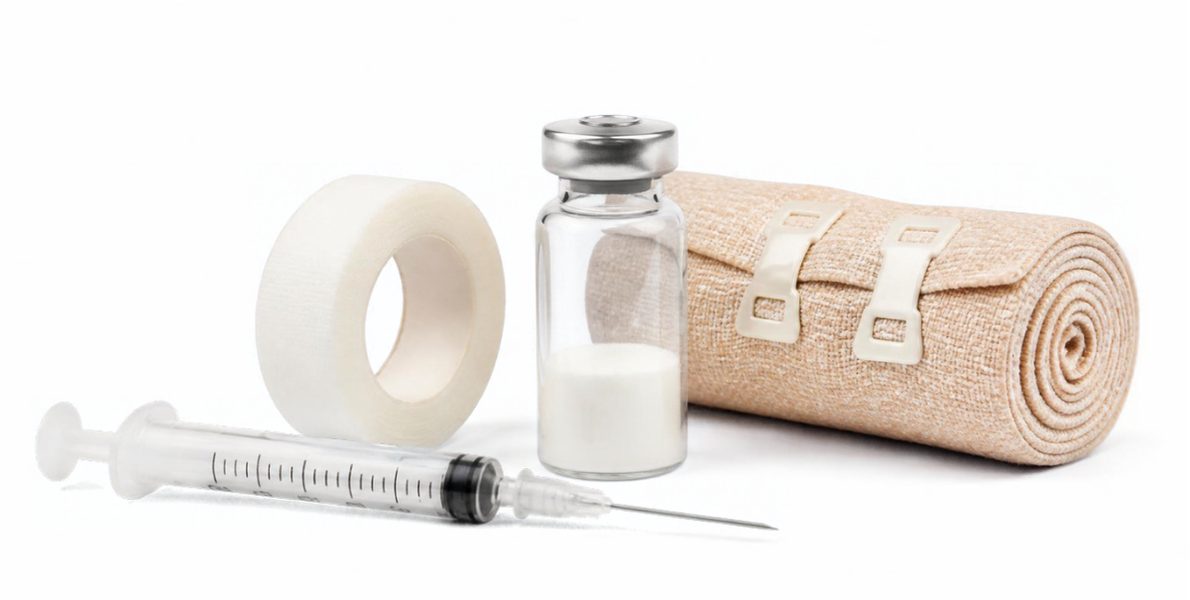
The majority of BPC-157 studies have involved injury models. Rat studies have focused on tendons, muscles, ligaments, and bones, with BPC-157 administered in different doses and routes. This article combines injury-specific dose data from the scientific literature so that the reader can be aware of which tissues were studied, what doses were used, which studies are not available, etc.
BPC-157 for Injury Recovery - What Was Studied
Tendon Healing Models in Rats
The model of Achilles tendon injury is one of the extensively explored modalities in BPC-157 studies. Staresinic et al. (2003) cut through Achilles tendon with the administration of BPC-157 in the doses of 10 mcg/kg IP for 14 days. The results indicating the improvement of biomechanical properties of healing tendon have been reported (PMID 14554208)
Cerovecki et al. (2010) extended this work by testing two doses, 10 mcg/kg and 10 ng/kg, both given IP for 14 days after MCL transection in rats. Both dose levels were associated with improved ligament healing outcomes, including better functional and biomechanical recovery (PMID 20225319). The finding that a dose 1000 times lower still produced measurable effects is notable and unexplained.
Muscle Crush and Laceration Studies
Muscle injury models provide another window into BPC-157 dosing for tissue repair. Brcic et al. (2009) used a quadriceps crush model in rats with daily IP injection of 10 mcg/kg BPC-157. The treated animals showed improved muscle healing markers compared to controls (PMID 20388964).
Novinscak et al. (2008) also studied muscle crush injury, testing both 10 mcg/kg and 10 ng/kg given IP. As in the tendon studies, both dose levels were associated with improved outcomes in the treated groups (PMID 18668315). The consistency of the dose-independent finding across tissue types raises pharmacological questions that have not been resolved.
Dosage Data From Injury-Specific Research
| Injury Model | Species | Dose | Route | Duration | Outcome | PMID |
|---|---|---|---|---|---|---|
| Achilles tendon transection | Rat | 10 mcg/kg | IP | 14 days | Improved tendon biomechanics | 14554208 |
| Achilles tendon transection | Rat | 10 mcg/kg, 10 ng/kg | IP | 14 days | Functional tendon recovery | 20225319 |
| Muscle/tendon healing | Rat | 10 mcg/kg daily | IP | Variable | Angiogenesis in muscle/tendon healing | 20388964 |
| Muscle crush | Rat | 10 mcg/kg, 10 ng/kg | IP | Variable | Muscle repair markers improved | 18668315 |
| MCL transection | Rat | Local injection | Local | Variable | Ligament healing | 21030672 |
| Bone defect | Rat | 10 mcg/kg | IP | Variable | Bone healing parameters | 10071911 |
| Colon anastomosis | Rat | 10 mcg/kg, 10 ng/kg | IP | Daily | Anastomotic strength | 18818478 |
Achilles Tendon - Doses and Timelines
Data on Achilles tendon injuries are the best among BPC-157 injuries database. Two studies, performed independently and using the same model, showed improvements after treatment with BPC-157 for two weeks. In both studies, researchers administered BPC-157 dosed at 10 mcg/kg IP.
Tendon data indicates that the administration of 10 mcg/kg through intraperitoneal injection to rats daily for two weeks results in better healing than saline control, but it does not tell whether any other dosing is better, whether subcutaneous administration is better than intraperitoneal administration, or the role of this research in its relevance to humans. If you need to work with reconstituted peptide in your laboratory, our reconstitution calculator can ensure that the correct concentration is prepared.
Muscle Crush and Angiogenesis Models
Brcic et al. (2009) and Novinscak et al. (2008) examined crush injuries to muscle using 10 mcg/kg IP dose. The crush technique allows for the creation of a standardized muscle injury that can be studied both histologically and functionally. However, it should be understood that crush injuries in rats do not fully replicate real-life muscle injuries in humans like sprains, partial tears, or contusions.
- Tissue types studied
- Tendon, muscle, ligament, bone, colon
- Most studied injury
- Achilles tendon transection (rat)
- Standard dose used
- 10 mcg/kg IP daily
- Lowest dose tested
- 10 ng/kg IP daily
- Typical study duration
- 14 days
- Human injury trials
- Zero published
Ligament and Bone Studies
MCL Transection in Rat Models
Chang et al. (2011) studied medial collateral ligament (MCL) transection in rats with local BPC-157 injection near the injury site. The study reported improved ligament healing in the treated group compared to controls (PMID 21030672). This is one of the few studies that used local injection rather than systemic IP delivery, making it more relevant to how someone might consider delivering a peptide to a specific injury site.
Nonetheless, the MCL study is just one experiment conducted in one species. The procedure, including the dose, number of injections, and injection plan for delivering treatment to local ligaments, has not been validated through other studies.
Fracture Healing - Limited but Published Data
Sebecic et al. (1999) examined BPC-157 at 10 mcg/kg IP in a rat bone healing model. Treated rats showed improved parameters of bone defect repair compared to controls (PMID 10071911). This is the primary published reference for BPC-157 and bone healing. The dataset is thin: one study, one dose level, one species.
For those considering BPC-157 in terms of fracture healing, we would like to clarify that one study done on rats does not serve as proof for human usage. The biology involved in bone healing is distinct between rodents and humans due to differences in the speed of healing, mechanical loading, and the patterns of remodeling.
What Injury Data Does Not Show
No Human Injury Trials Exist
All the information found on this page comes from rat studies. There has been no any other human study to analyze how BPC-157 works on different injuries in humans. Hence, it is not clear how many doses of BPC-157 would be needed by people in order to recover from injuries, at what time frame after the treatment a patient could expect recovery and how BPC-157 could perform against other common treatments available for injuries like surgery and physical therapy.
Tissue-Specific Dose Optimization Not Studied
The same dosage of (10 mcg/kg) was used for tendons, muscles, ligaments, and bones in the research. There is a lack of data to suggest that this dosage is ideal for these kinds of tissues. Each tissue has its own way of getting blood, receiving receptors, and healing. One dose for all tissues is still not proven. Deciding to use one dosage for all was not based on scientific evidence but rather on practical reasons.
Combining With Physical Rehabilitation - Unstudied
There is no research study that has integrated BPC-157 in any physical rehabilitation, exercise, or mechanical loading procedure under study. Physical therapy plays an important role in the recovery of injuries, and it is unclear if BPC-157 will affect mechanical loading during the healing process.
FAQ - BPC-157 and Injury
What injuries has BPC-157 been tested on?
With regards to animal models, the following procedures were used: Achilles tendon transection, muscle crush injury, medial collateral ligament transection, bone defects, and colon anastomosis. Every study on these models was done using rats. In terms of injury studies, tendon and muscle injuries have been the most researched since the various studies have similar dose protocols (PMID 29879879).
Does BPC-157 help tendons heal?
The daily IP injection of 10 mcg/kg of BPC-157 for 14 days in rats with surgically cut Achilles tendons resulted in better tendon function than saline-treated control rats. At least two published studies confirmed this finding. It is currently unclear if this result can be applied to human tendon injuries, partial tears, tendinopathy, or any other tendon conditions.
Can BPC-157 replace physical therapy?
The assertion is unfounded. There is no research that has examined BPC-157 as compared to performing physical therapy, combined BPC-157 with physical therapy, or tested the claim that BPC-157 can eliminate the need for rehabilitation. Physical therapy is still the evidence-based practice in the recovery of humans from musculoskeletal injuries. There has been no research that has investigated BPC-157 in this context.
There are currently no regulatory agencies that have approved BPC-157 for human use. It is sold solely for research purposes. Anyone suffering from an injury should consult with a licensed physician in order to get treatment based on evidence. They should also keep in mind that there is no information on the drug's effectiveness or safety specifically for humans.
Compare the current picks
Prices, sizes and ratings side by side, updated when the merchant pages change.
Compare sources