Oral BPC-157 Dosage — What Studies Used
Oral BPC-157 dosage figures from published animal studies. Routes, amounts per kg, and why capsule dosing has no established human protocol.
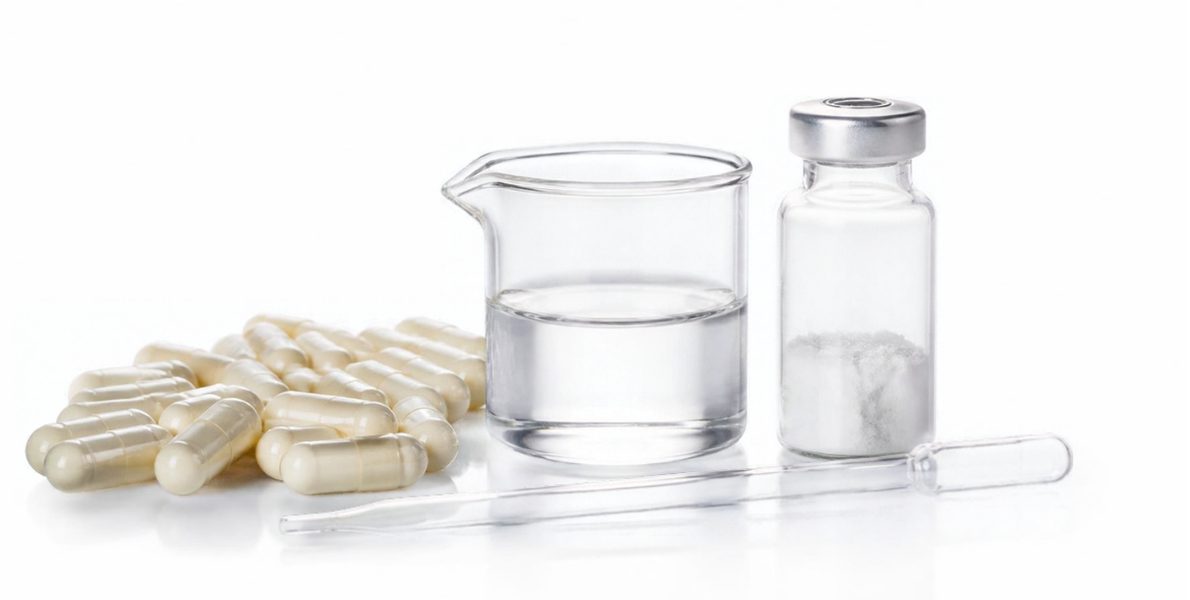
The majority of research done on BPC-157 has used injections to deliver the substance. However, there are a few studies that did look at the oral delivery of the peptide. On this page, we have compiled some of the oral delivery research done so far, including the doses being tested in the studies.
Oral BPC-157 Dosage - What Animal Studies Administered
The use of BPC-157 as an oral medication is most observed in studies of gastrointestinal protection. The question remains whether the peptide ingested into the stomach can have any local and/or systemic effect. In rats, the answer is conditional yes.
Gavage Doses in Rat Gastrointestinal Models
Gavage refers to the process of inserting a tube into the stomach to administer substances without the chewing and involuntary swallowing process. This is the method that researchers use more often when it comes to researching peptides in rodents because it helps with exact measurement of doses and volumes.
Sikiric and his partners (1999) administered BPC-157 at 10 mcg/kg of body weight through intragastric gavage to rats in a rat gastric cytoprotection model. The same research team tested a significantly lower quantity of 10 ng/kg by the same means. Both of these doses had a protective effect against ethanol-induced stomach lesions in the animals studied (PMID 9920181). In another research done earlier, Sikiric and his collaborators (1993) also used the oral route along with the intraperitoneal application of the drug in anti-ulcer studies in rats with multiple dose levels (PMID 8298609).
It is important to clarify what gavage does and does not simulate. While it delivers food directly to the stomach, it does not replicate the act of swallowing a capsule, which involves the role of saliva, the time taken for passage through the esophagus, and the variable rates at which food gets released from the stomach.
Drinking-Water Administration in Mouse Studies
Protocols existed in which BPC-157 was administered to animals via drinking water, so providing ad libitum access to the compound. While this method is not as accurate because water consumption varies between individuals, it provides a more authentic oral exposure pattern. The work by Sikiric and colleagues (2018) was able to compile and analyze many studies using this method of administration and noted that the BPC-157 treatment via drinking water at doses of approximately 10 mcg/kg and 10 ng/kg had a significant effect in various models of rats and mice (PMID 29879879).
The concentration of peptide in drinking water was determined based on average daily water intake and weight of the organism. This is not a method that is easily translated to the human dose calculation process.
Oral vs Parenteral BPC-157 in Research
Bioavailability Differences Observed in Rodents
A number of studies have compared both oral and injectable delivery methods at the same time, and both methods were shown to lead to some results for the measured endpoints, although the magnitude sometimes differed.
| Study | Species | Oral Dose | Injectable Dose | Route Comparison | PMID |
|---|---|---|---|---|---|
| Sikiric et al. 1999 | Rat | 10 mcg/kg PO (gavage) | 10 mcg/kg IP | Both effective in gastric cytoprotection | 9920181 |
| Sikiric et al. 1993 | Rat | Multiple PO doses | Multiple IP doses | Anti-ulcer effects observed with both routes | 8298609 |
| Sikiric et al. 2018 (review) | Rat/Mouse | 10 mcg/kg, 10 ng/kg PO | 10 mcg/kg, 10 ng/kg IP | Comparable activity reported across models | 29879879 |
| Klicek et al. 2008 | Rat | 10 mcg/kg, 10 ng/kg PO (drinking water) | 10 mcg/kg, 10 ng/kg IP | Colon anastomosis healing with both routes | 18818478 |
There has been no official bioavailability study conducted with plasma concentration measurements for BPC-157 in any species. The peptide has shown beneficial effects in studies with oral administration in rats, but it is unknown what percentage of the substance entered the systemic circulation and how much acted locally in the intestines.
Why Oral Data Cannot Set a Human Capsule Dose
Three barriers hinder the drawing parallels between rodent dosage recommendations and those for humans. The first barrier is related to significant differences in various parameters including gastric pH, enzyme profiles, and transit times in rats and humans. The second barrier is the total absence of pharmacokinetic data on BPC-157 in various species so the rate of absorption cannot be specified. The last barrier is that the stability of the peptide in capsules kept at room temperature can differ significantly from that of the peptide administered immediately from the solution by gavage.
These are not minor technical details. They are foundational unknowns.
BPC-157 Capsule Products - What Vendors Sell
Capsule Sizes on the Market vs Study Amounts
Standard capsule products have either 250 mcg or 500 mcg of BPC-157 per capsule. A few vendors sell capsules containing 750 mcg or even 1000 mcg of BPC-157. The values for these amounts were not obtained from any published dose-response studies conducted on humans since there aren't any.
- Most common rat oral dose
- 10 mcg/kg body weight
- Lowest tested rat oral dose
- 10 ng/kg body weight
- Typical commercial capsule
- 250-500 mcg fixed dose
- Human oral bioavailability data
- None published
- Human dose-response data
- None published
To put the numbers in perspective: a 10 mcg/kg dose for a 250-gram rat equals 2.5 mcg total. A 500 mcg capsule marketed for human use contains 200 times that absolute amount. Whether allometric scaling justifies that difference is debatable, and the debate itself is academic because no controlled human data anchor it. Our reconstitution calculator can help with concentration math for liquid preparations, though it does not resolve the fundamental dosing question for oral use.
What the Oral Data Does Not Establish
No Dose-Response Curve in Humans
The term dose-response curve refers to the relationship between dosage of the substance and the extent of its effect. Humans appear not to have a clear dose-response curve for taking BPC-157 orally. Animals tested showed weak evidence of such a curve. Most studies have administered one or two doses of this compound and reported only binary outcomes (presence of a lesion or absence of it; overlapping of peptide treatment in the healing process or its absence). At this time, it is quite apparent that no thorough studies exists in all investigated species to determine the threshold and effectiveness of oral doses of the peptide.
Stability and Absorption Questions Still Open
BPC-157 is a peptide made up of 15 amino acids. Generally speaking, peptides of this size are vulnerable to breakdown by enzymes in the digestive tract. The observation that orally administered BPC-157 exhibited effects in rat studies raises the issue of whether it acts locally in the gut lining or whether it may be active in fragmented form or whether this specific sequence of peptide has some unusual protease stability. Existing literature fails to clarify these questions.
Capsule formulation presents new factors that can be cautiously examined. The effect of enteric coating, filler materials, and storage conditions on the stability of peptides should be investigated. There are no studies available on the stability and efficacy of peptides using commercial BPC-157 capsules.
FAQ - Oral BPC-157
Can BPC-157 survive stomach acid?
According to previous studies, BPC-157 is stable in gastric juice when studied in vitro, which is out of ordinary for peptides. Sikiric et al. (2018) emphasized this stability as a unique trait (PMID 29879879). Nevertheless, there is a significant difference between laboratory observations and surviving the entire human digestive tract. There is yet no report on degree of absorption in humans.
Are BPC-157 capsules the same as injectable vials?
Not really. BPC-157 products in injections are usually lyophilized powders meant to be dissolved in bacteriostatic water. The capsules contain the powder filled into gelatin or vegetable shells and sometimes use excipients and flow agents. While the peptide sequence may be the same, the products differ in terms of formulation and purity. Results of testing by third parties have on occasion revealed inconsistencies between the peptide amounts stated on labels and actual amounts in the products.
What oral doses did researchers use in rats?
According to the report, the two dosages for BPC-157 that have been used most often during the research are these: 10 mcg/kg and 10 ng/kg (given either by oral administration or dissolved in water). Such doses were tested on rats, the weight of which was approximately 200-300 grams. Hence, the overall amount of peptide per dose for one rat was so equal to a small range of both micrograms and nanograms, which is significantly lower than the amount of BPC-157 found in human capsules when adjusted for body weight.
BPC-157 has not received regulatory agency approval for human use. This compound is sold for research purposes. So anyone interested in working with BPC-157 in any form should consult their doctor and understand that there is no safety or efficacy information based on clinical trials.
Compare the current picks
Prices, sizes and ratings side by side, updated when the merchant pages change.
Compare sources