BPC-157 Cycle Length and Advanced Dosage Patterns
BPC-157 cycle lengths reported in animal studies. Duration ranges from 7 to 72 days — what researchers tested and what remains unknown.
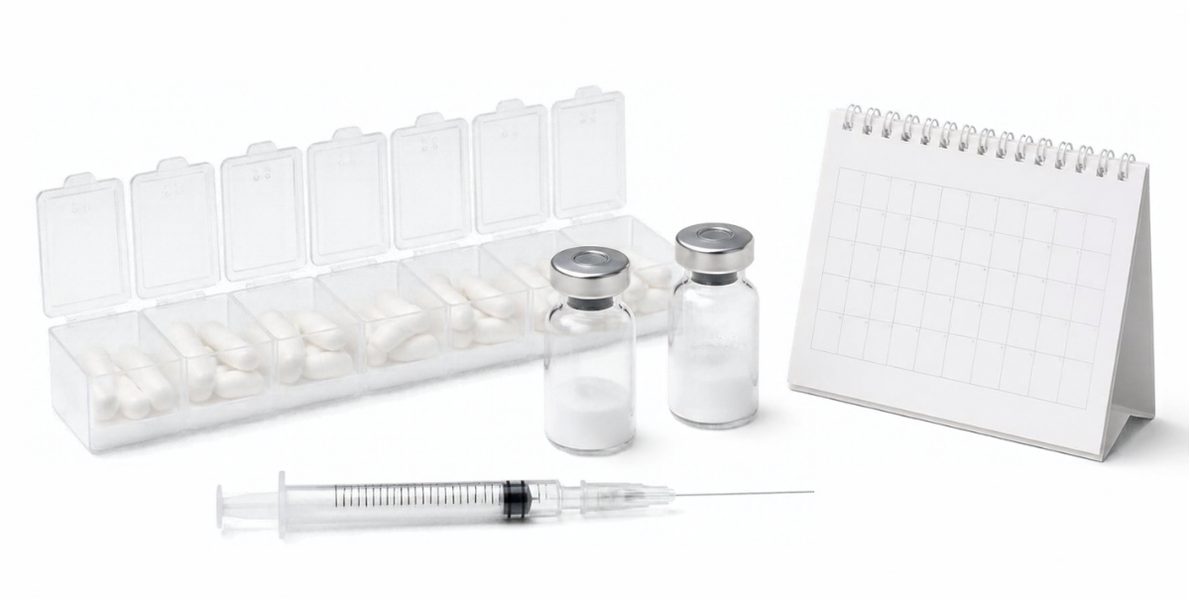
The term "cycle" suggests that substance use is initiated, terminated and possibly restarted according to a schedule. The current literature related to BPC-157 has no information about cycling protocols. Instead, it consists of study durations, which may represent single-dose tests or multiple-week experiments of the use of the substance in rodents. This page presents the study durations and outlines the rationale behind the lack of research support for the idea of an "advanced cycle".
BPC-157 Cycle Length - What Researchers Actually Tested
Short Protocols - 7 to 14 Day Studies
The most common study duration in BPC-157 research was 14 days. Staresinic et al. (2003) administered BPC-157 at 10 mcg/kg IP daily for 14 days in their rat Achilles tendon model (PMID 14554208). Cerovecki et al. (2010) used the same 14-day duration with two dose levels, 10 mcg/kg and 10 ng/kg, for MCL healing (PMID 20225319).
A few research attempts lasted shorter than others. Novinscak et al. (2008) investigated the healing of muscle crush injuries in the presence of BPC-157 exposure of different lengths, as well as tissue assessment at multiple points in time in the course of the research (PMID 18668315). The period of 7 to 14 days appears again and again in this paper as it fits with the natural timelines of healing of rat injuries which are studied here.
Extended Protocols - 28 to 72 Day Durations
Longer durations appear in the literature but are less common. Sikiric et al. (2018) reviewed studies with various treatment periods, some extending beyond four weeks (PMID 29879879). The longer durations typically appeared in models of chronic conditions or slower-healing injuries, not because researchers were testing whether extended administration was more effective than shorter courses.
No study has been found in which the short duration was compared with the long duration using the same dose and model in order to estimate the optimal treatment length.
Cycle Patterns in Published Literature
| Study | Species | Duration | Dose | Route | Model | PMID |
|---|---|---|---|---|---|---|
| Staresinic et al. 2003 | Rat | 14 days | 10 mcg/kg | IP | Achilles tendon transection | 14554208 |
| Cerovecki et al. 2010 | Rat | 14 days | 10 mcg/kg, 10 ng/kg | IP | MCL healing | 20225319 |
| Brcic et al. 2009 | Rat | Daily (varied endpoints) | 10 mcg/kg | IP | Muscle/tendon angiogenesis | 20388964 |
| Sikiric et al. 1993 | Rat | Variable | Multiple doses | IP | Anti-ulcer | 8298609 |
| Klicek et al. 2008 | Rat | Daily dosing | 10 mcg/kg, 10 ng/kg | IP | Colon anastomosis | 18818478 |
| Sebecic et al. 1999 | Rabbit | Variable | 10 mcg/kg | IP | Bone healing | 10071911 |
| Novinscak et al. 2008 | Rat | Variable (multi-timepoint) | 10 mcg/kg, 10 ng/kg | IP | Muscle crush | 18668315 |
Continuous Daily Dosing in Most Models
All the studies that we considered involved application of continuous daily dosage from the beginning of the study until the study endpoint or termination. There were no breaks. There were no periods of no treatment or dose tapering. Animals were given the same amount from day one until the end of each study. This is standard operating procedure in pharmacology.
No Cycling or Tapering Protocol in Any Study
The notion of cycling where a person takes a substance for a certain amount of weeks, has a break period and continues again is not found in the BPC-157 literature. Tapering refers to gradually decreasing the amount of the substance taken before stopping. Both approaches are taken from different contexts (anabolic steroids for instance), and applied to BPC-157 despite not having evidence to support their use.
Sikiric et al. (1999) applied the continuous dosing technique in their stomach cytoprotection study, which was used earlier in the same group's studies on anti-ulcer remedies (PMID 9920181). Klicek et al. (2008) used BPC-157 for consecutive days of daily treatment in their colorectal anastomosis experiment (PMID 18818478). The same approach was observed for all musculoskeletal and gastrointestinal studies, initiation of treatment, continuing treatment daily, and euthanasia at the conclusion of the study.
Advanced Considerations From the Data
Repeated Courses - Were They Studied?
There were no sources indicating that a research study published so far has observed animals that were treated with BPC-157, were withdrawn from treatment, and were then treated a second time. Only studies with continuous administration were referenced. So it remains unknown whether or not an identical effect, a less pronounced effect, or an increased effect would be obtained whenever BPC-157 was administered several times.
It is important to keep this in mind because "repeat courses" is an issue frequently debated in online discussions. The question of whether people should try BPC-157 again after a hiatus is often raised, but unfortunately no scientist has investigated this particular question in a controlled trial.
Washout Periods - No Published Data
The period of time between the end of one treatment and the start of another one (or the same one again) is known as a washout period. This is important because the washout period has a direct correlation to the effects the first treatment has on the second treatment as a result of remaining effects from the previous course of treatment. In the case of BPC-157, there has not been any washout data available because there has not been any study done that used a repeated course design.
Due to the absence of pharmacokinetic data in any species as far as the duration of presence of BPC-157 or its metabolites after treatment, it is impossible to assess the proper washout period. This gap goes as far as raising the practical question of whether the effects of BPC-157 last after the treatment is stopped. Some studies have looked at the consequences of treatment at different periods after the treatment, but the studies focus on the process of healing rather than presence or activity of the peptide.
For those involved in long-term research programs that involve preparation of reconstituted peptide solutions, our reconstitution calculator can prove to be highly useful in achieving uniform concentration throughout their work.
Why "Advanced Cycles" Are Speculation
No Human Trial Has Tested Cycle Variations
The term "advanced cycles" has been used prominently in online communities, where individuals prescribe higher doses or peers in combination with other peptides for extended periods. Nevertheless, these combinations have not been subjected to any known research conducted. The term "advanced" suggests improvements on a well-studied and scientifically proven base protocol. However, such industry-standard protocols have yet to be developed.
Animal Data Shows Duration, Not Optimization
The work with rats has shown that BPC-157 delivered every day for 14 days was correlated with better healing outcomes in injury models. However, it does not tell us if the same results would have been obtained with 7 instead of 14 days or if using 28 days would have produced better outcomes. The durations were chosen based not on how to optimize using BPC-157, but on the biology of the injury model.
We believe this distinction is very significant. The study duration of 14 days corresponds to the experimental design choices but is not intended as a recommendation for treatment.
Look at the case of antibiotics. Experts recommended a 10-day course of amoxicillin for treating strep throat based on several clinical trials that examined different courses of treatment and their relapse rates. It is an example of evidence-based medicine. In the case of BPC-157, a 14-day protocol was used for rats since this is the period that a rat's Achilles tendon needs to heal. So it is not that 14 days is any better than either 10 or 21 days when it comes to the peptide. The two cases may seem similar but are quite different when it comes to their evidential foundations.
FAQ - BPC-157 Cycle
How long were BPC-157 studies?
Most published BPC-157 studies administered the peptide daily for 7 to 14 days. A smaller number of studies extended treatment to 28 days or longer. These durations were determined by the healing timeline of the animal injury model being studied, not by optimization of the BPC-157 treatment itself. No study compared different treatment durations head-to-head (PMID 29879879).
Do you need to cycle off BPC-157?
The question has not been explored in any published articles. The idea of cycling off, which involves temporarily abstaining from a substance, was not included in the protocols of any of the BPC-157 studies. Animals received a continuous daily dose of the compound for the entire study. What effect stopping a drug and then taking it again has is unknown.
Is there a maximum cycle length?
No maximum treatment duration has been established for BPC-157 in any species. The longest study durations in the published literature extend to several weeks, but these were not designed to find an upper limit. Sikiric et al. (2010) noted the absence of observed toxicity across the studies reviewed, but this reflects the limited range of durations and doses tested, not a comprehensive safety assessment (PMID 20166993).
BPC-157 has yet to be approved for use in humans by any other regulatory body. It is available only for laboratory research. So you need to consult a licensed practitioner before handling this substance. There isn’t any clinical research on its use in humans, meaning you won’t have any information on the cycle length, duration of cycle, or dosing efficiency that can be considered safe.
Compare the current picks
Prices, sizes and ratings side by side, updated when the merchant pages change.
Compare sources